113 - 117 AD
Trajan's Column
Rome's spiral chronicle of empire
Rising 30 meters in the heart of Rome, Trajan's Column is a monument unlike any other. Its continuous spiral frieze - 200 meters of carved marble - unspools the epic story of Emperor Trajan's Dacian Wars in 155 individual scenes. Completed in 113 AD under the architect Apollodorus of Damascus, the column served as both a war memorial and a dynastic statement: a cinematic narrative carved in stone that has inspired architects, artists, and emperors for nearly two millennia.
Explore the frieze
Trajan's Column, Rome. Photo: Wikimedia Commons (public domain)
Explore the Spiral Frieze
Column cross-section & frontal views
Relief Panel Gallery
Browse the spiral frieze scene by scene. Select a panel to see a closer view and detailed annotations.
140 additional panels not yet added
Historical context
Emperor, architect, and empire
Emperor Trajan
Marcus Ulpius Traianus (53 - 117 AD) was Roman emperor from 98 AD until his death. Remembered as the second of the "Five Good Emperors," Trajan presided over the greatest territorial expansion in Roman history. His campaigns against the Dacian kingdom (101 - 102 AD and 105 - 106 AD) brought vast wealth to Rome from the Dacian gold mines and funded an unprecedented building program - of which the column was the crowning monument.
The Dacian Wars
Decebalus, king of Dacia (modern Romania), had been a persistent threat to Rome's Danubian frontier. Trajan's two campaigns - both depicted in detail on the column's frieze - culminated in the complete subjugation of Dacia and the suicide of Decebalus. The wars were brutal and total: the column shows not only battles and sieges but also diplomacy, engineering, and the human cost of conquest.
Apollodorus of Damascus
Trajan's chief military engineer and court architect, Apollodorus of Damascus (active c. 97 - 130 AD) designed the Forum of Trajan, the Column, and the massive bridge over the Danube. A Greek from Syria, Apollodorus was one of antiquity's greatest engineers. He is credited with the column's structural innovation: a hollow interior with a spiral staircase carved into the solid marble, allowing visitors to ascend to a viewing platform at the top.
Architectural details
Marble, measurement, and mastery
Materials
The column is carved from Luna marble (Carrara marble), quarried in Tuscany. Each of the 19 colossal drums weighs approximately 32 tonnes. The marble was chosen for its fine grain, which allowed the sculptors to achieve extraordinary detail.
Dimensions
The column stands 29.78 m (97.7 ft) tall on a 5.37 m (17.6 ft) pedestal, for a total of 35.15 m (115.3 ft). The shaft is 3.67 m (12.0 ft) in diameter. The viewing platform originally held a bronze statue of Trajan - replaced by a statue of Saint Peter in 1588.
Spiral Staircase
Inside the column, a helical staircase of 185 steps rises to the capital. Light enters through narrow slits cut into the marble, strategically placed to illuminate the interior. This was an architectural first - no earlier Roman monument had an internal spiral staircase.
Pedestal & Inscription
The pedestal is decorated with carved trophies of Dacian weapons. The original inscription, in Trajan's own hand, dedicates the column to the Senate and People of Rome. A chamber at the base later held Trajan's golden urn with his ashes.
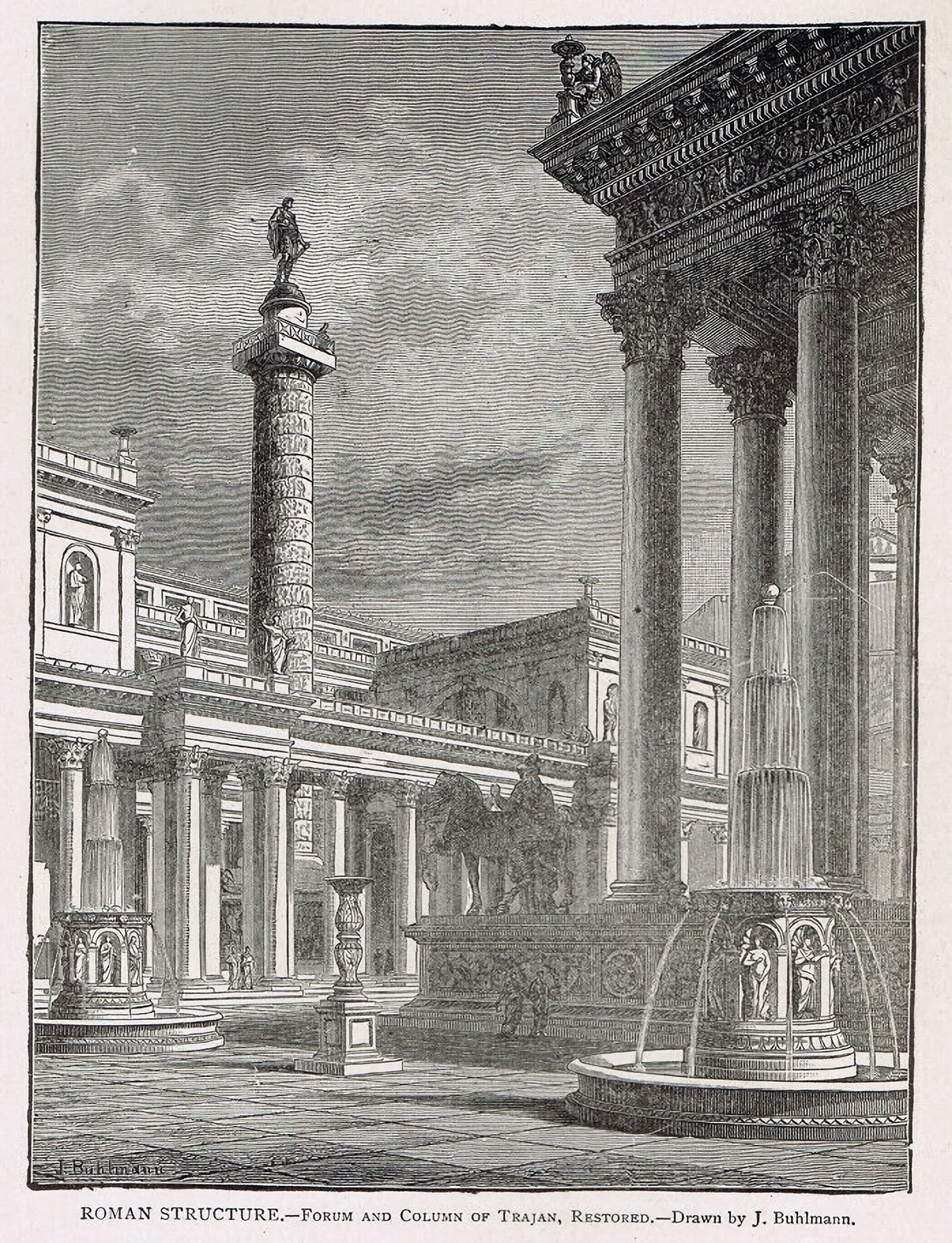
Artistic analysis
The world's first cinematic narrative
Relief style
The column's frieze is carved in low relief (bas-relief), with varying depth to create perspective. The figures are about 60 cm tall, growing slightly taller in the upper bands to compensate for the viewing distance from ground level. The sculptors employed a remarkably naturalistic style, with individualized faces, detailed armor, and expressive postures that anticipate later Roman historical reliefs.
Narrative technique
The frieze reads chronologically from bottom to top, wrapping around the column 23 times. The first half depicts the First Dacian War; the second half the Second Dacian War. Trajan appears in over 60 scenes, always the central, commanding figure. The narrative moves seamlessly between battle, construction, diplomacy, and ritual - a visual language that influenced the Column of Marcus Aurelius and, centuries later, the Bayeux Tapestry and modern cinematic storytelling.
Key narrative innovations include: continuous narration (same characters appearing multiple times), aerial perspective (landscape as background shorthand), and emotional cues (posture, gesture, and grouping to convey morale).
Influence and legacy
Trajan's Column established the spiral narrative column as a genre in Roman art. The Column of Marcus Aurelius (c. 193 AD) directly emulated its form and concept. Renaissance artists from Raphael to Mantegna studied and sketched the reliefs. In the modern era, casts of the column are displayed at the Victoria and Albert Museum in London and the Museo della Civiltà Romana in Rome. The column's structural ingenuity - a monumental hollow shaft with internal stairs - influenced the design of later victory columns, lighthouses, and even skyscrapers.